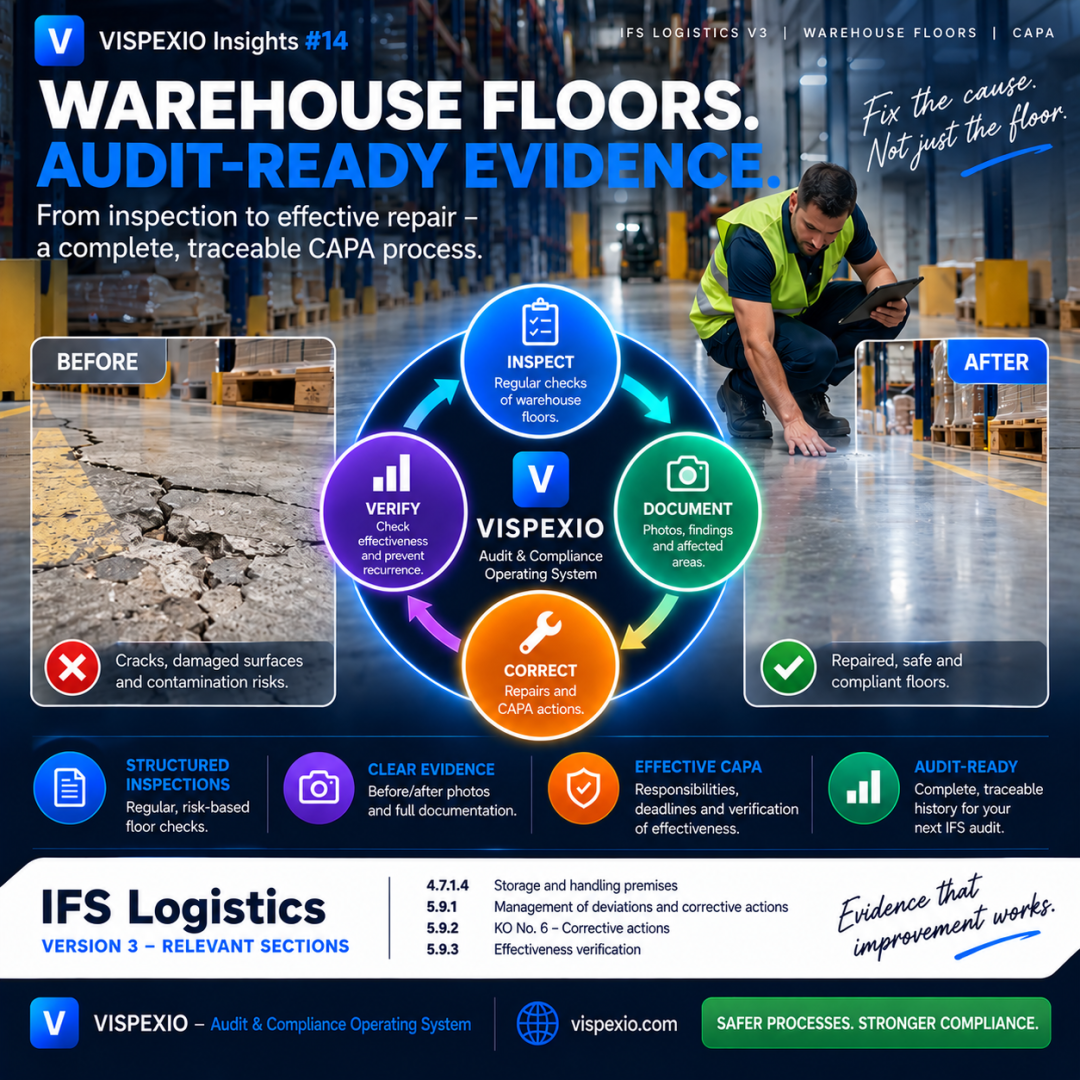
IFS Logistics v3: Warehouse Floor Inspections, Repairs and CAPA Effectiveness Verification
A real question from an IFS Logistics audit
During a recent IFS Logistics Version 3 recertification audit, an auditor raised a seemingly simple question:
“How do you ensure that warehouse floors are inspected regularly, identified damage is repaired promptly and the effectiveness of the repairs is demonstrably verified?”
The question concerned a logistics warehouse handling food products alongside other goods. Operations include storage, cross-docking, full truckload (FTL), less-than-truckload (LTL) and general cargo handling.
In such environments, warehouse floors are exposed to considerable mechanical stress every day.
Forklifts, pallet movements, heavy loads and frequent handling activities can cause cracks, concrete spalling and surface deterioration.
These issues are not simply maintenance concerns.
Damaged floors may make cleaning more difficult, encourage dirt accumulation, increase contamination risks and affect operational safety.
A documented, regularly implemented inspection and maintenance process is therefore essential.
What does IFS Logistics Version 3 require?
Several sections of the standard are particularly relevant to this practical case.
Section 4.7.1.4 – Storage and handling premises
IFS Logistics establishes requirements for the design, construction and maintenance of floors, walls and ceilings.
These areas must be maintained in a manner that minimises dirt accumulation and contamination risks.
For warehouse floors, this means considering:
- Suitable structural and hygienic conditions.
- Identification of relevant damage.
- Appropriate maintenance and repairs.
- Cleanability and contamination prevention.
- Traceable operational monitoring.
The official IFS audit checklist also addresses floor conditions, the frequency of site inspections and previous maintenance activities.
Section 5.9.1 – Management of deviations and corrective actions
Identified deviations must be recorded, analysed and appropriately addressed.
Root cause analysis is required for certain deviations and non-conformities, including those related to product safety or recurring issues.
A damaged warehouse floor may therefore require more than a simple repair request.
Depending on the risk, severity and recurrence, the organisation must determine why the damage occurred and which actions are necessary.
Section 5.9.2 – KO Requirement No. 6
Corrective actions must be formulated, documented and implemented.
This includes:
- Defined responsibilities.
- Appropriate implementation deadlines.
- Traceable corrective actions.
- Documented completion.
A verbal promise to repair a damaged floor is not sufficient evidence of a completed corrective-action process.
Section 5.9.3 – Effectiveness verification
The effectiveness of implemented corrections and corrective actions must be evaluated, and the results must be documented.
For warehouse floor repairs, this may involve verifying:
Was the damaged surface repaired properly?
Can the repaired area be cleaned effectively?
Have the identified product safety risks been eliminated?
Is the damage recurring?
Important: IFS Logistics does not explicitly prescribe before-and-after photographs as the mandatory documentation format for this situation. However, they provide a particularly practical and transparent way to demonstrate the condition before and after a repair.
Why paper, Excel and isolated repair requests are not enough
Many logistics companies already identify and repair damaged warehouse floors.
The real challenge is often the missing connection between inspections, findings, repairs and effectiveness verification.
A typical situation may look like this:
- A forklift operator reports floor damage.
- The warehouse manager informs maintenance.
- A repair is commissioned verbally.
- A photograph remains on a smartphone.
- The repair invoice is stored in accounting.
- No documented effectiveness verification takes place.
The repair may have been completed successfully.
Nevertheless, the evidence of the complete process may be missing during the next audit.
A structured digital control process closes this gap.
The solution: A dedicated VISPEXIO warehouse floor inspection Run
A digital control process has now been implemented in VISPEXIO for this specific use case.
It connects recurring condition inspections with documented findings, repair activities and effectiveness verification.
1. Regular warehouse floor inspections
Warehouse floors and traffic areas are inspected using predefined control points.
Inspection frequency is determined through operational risk assessment, considering traffic intensity, usage and floor condition.
Typical inspection criteria include:
- Cracks in concrete.
- Concrete spalling and surface damage.
- Damaged floor coatings.
- Uneven or deteriorated transitions.
- Areas that are difficult to clean.
- Potential contamination or safety risks.
2. Digital documentation with before-repair photographs
When damage is identified, the finding is documented directly within the VISPEXIO Run.
The documentation can include:
- Affected warehouse area or checkpoint.
- Type and extent of damage.
- Description of the finding.
- Photographic evidence before repair.
- Assessment of required actions.
This ensures that the finding remains connected to the relevant inspection.
3. Immediate corrections and CAPA
Depending on the risk assessment, immediate protective measures may be necessary.
These could include marking or temporarily restricting access to an affected area.
Required repairs and, where appropriate, further corrective actions are then defined.
Responsibilities, deadlines and progress are documented and tracked.
Recurring damage may also require root cause analysis, considering factors such as traffic loads, floor construction or operational practices.
4. Repair documentation with after-repair photographs
Once the repair is completed, the restored condition is documented.
An after-repair photograph complements the original finding.
The original damage and the repaired condition can therefore be compared directly.
5. Effectiveness verification
Completing a repair does not automatically demonstrate its effectiveness.
The outcome must also be assessed and documented.
Relevant questions include:
- Was the damaged area repaired properly and completely?
- Is the surface sufficiently cleanable again?
- Have the identified risks been addressed?
- Are additional measures necessary?
- Do subsequent inspections reveal recurring damage?
The results of the effectiveness assessment are recorded.
6. Audit-ready evidence history
Connecting inspections, findings, photographs, actions and effectiveness assessments creates a transparent evidence history.
During a future internal review or IFS Logistics audit, the organisation can demonstrate how damage was identified, addressed and verified.
From an isolated defect to continuous improvement
The main advantage is not simply digital documentation.
Regular recurring inspections create a continuous process that helps identify new damage early and supports systematic root cause analysis when problems recur.
An individual repair becomes part of a traceable quality and improvement process.
Inspection → Evidence → Deviation → CAPA → Repair → Effectiveness Verification
Conclusion: Don't just repair the floor. Prove the improvement.
This real recertification audit case highlights an important principle.
An auditor does not only want to know whether a damaged warehouse floor has been repaired.
The auditor wants to understand how damage is systematically identified, appropriate actions are implemented and their effectiveness is verified.
VISPEXIO supports this process through structured digital Runs, photographic documentation, CAPA tracking and documented effectiveness assessments.
For warehousing, food logistics, cross-docking and other operational environments requiring reliable controls.
From damaged warehouse floors to documented continuous improvement.
VISPEXIO – Audit & Compliance Operating System
Normative references
- IFS Logistics Version 3, Section 4.7.1.4 – Storage and handling premises.
- IFS Logistics Version 3, Section 5.9.1 – Management of deviations and corrective actions.
- IFS Logistics Version 3, Section 5.9.2 – KO Requirement No. 6.
- IFS Logistics Version 3, Section 5.9.3 – Effectiveness verification.
Inspection frequency and implementation must be determined according to operational risks and applicable requirements. VISPEXIO supports execution and documentation but does not replace professional risk assessment or the organisation's responsibility for compliance.